News
Impact Story: From the Placemaking Wales Charter to Local Strategies
How the Design Commission for Wales helped shape a shared understanding of placemaking in Wales, supported its use in local strategies and strengthened those strategies through independent review.
Placemaking is about more than the appearance of buildings or improvements to public spaces. It considers how different elements of a place work together: where things are located, how they connect, how people use them and how they experience their surroundings.
This case study explores our role in developing national placemaking policy and how the resulting principles were used to develop strategies for Ammanford, Carmarthen and Llanelli. It also looks at how our independent review helped strengthen the strategies before publication.
Creating a shared language for placemaking
Planning Policy Wales Edition 10, published in December 2018, placed placemaking at the heart of national planning policy. Although we had worked with Welsh Government as this approach developed, there was still uncertainty about what placemaking meant in practice.
A shared understanding was needed to demonstrate that placemaking was not simply about how a place looks, but also how people use it and how it makes them feel.
Working with Welsh Government, we brought together the Placemaking Wales Partnership. The group included professionals from architecture, planning, surveying, landscape, highways, housing and academia, alongside colleagues from different parts of Welsh Government.
Together, the partnership co-produced the Placemaking Wales Charter, bringing different professional perspectives into six principles that describe placemaking as a whole.
The process created space for genuine debate. Each profession wanted its priorities, from heritage and green infrastructure to accessibility, to be represented. Working together helped the group develop language broad enough to reflect placemaking as a whole, without allowing any one issue to dominate.
The six principles of the Placemaking Wales Charter
-
People and community – Involving local communities in the planning process and considering their needs, health and wellbeing.
-
Location – Promoting efficient land use, sustainable locations, and facilities that reduce the need to travel.
-
Identity – Valuing and respecting the positive, distinctive qualities and character of existing places.
-
Movement – Prioritising walking, cycling and public transport to reduce car dependency and offer travel choices.
-
Mix of uses – Creating places with a range of functions, including housing, jobs and services, to support vibrant and self-sustaining communities.
-
Public realm – Designing well-defined, welcoming, safe, inclusive and distinctive streets and public spaces.
The Charter was designed as a positive commitment, rather than a compliance tool. Organisations sign up to recognise and strengthen their contribution to placemaking. Members of the partnership became its first signatories when it was launched online in September 2020.
Putting policy into practice
The launch of the Charter was only the beginning. Our continuing role has been to help translate the policy into practice.
We have produced guidance, events, case studies, newsletters and other resources, while supporting the partnership and encouraging signatories to reflect on their work.
This has helped broaden the conversation beyond how public spaces look, towards whether the right things are in the right places and connected effectively.
The principles have also informed other policy and guidance. Welsh Government’s Place Division used them in its requirements for placemaking plans, while Transport for Wales adapted them into its own language rather than developing a separate framework.
The breadth of the partnership was one of its main strengths. Placemaking does not sit with one profession, service or organisation. Bringing different disciplines together demonstrated why they need to work collaboratively and how their decisions combine to shape a place.
There was also learning from the process. Although people and community were strongly represented in the principles, engagement and inclusion specialists were not directly involved in the original group. We have sought to address this since, continuing to create opportunities for different professional groups to work together.
A national framework used locally
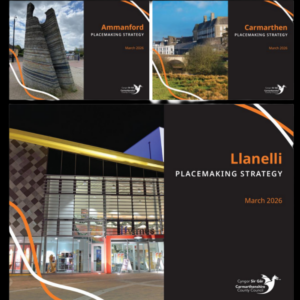
Carmarthenshire County Council commissioned Urban Foundry to develop placemaking strategies for Ammanford, Carmarthen and Llanelli.
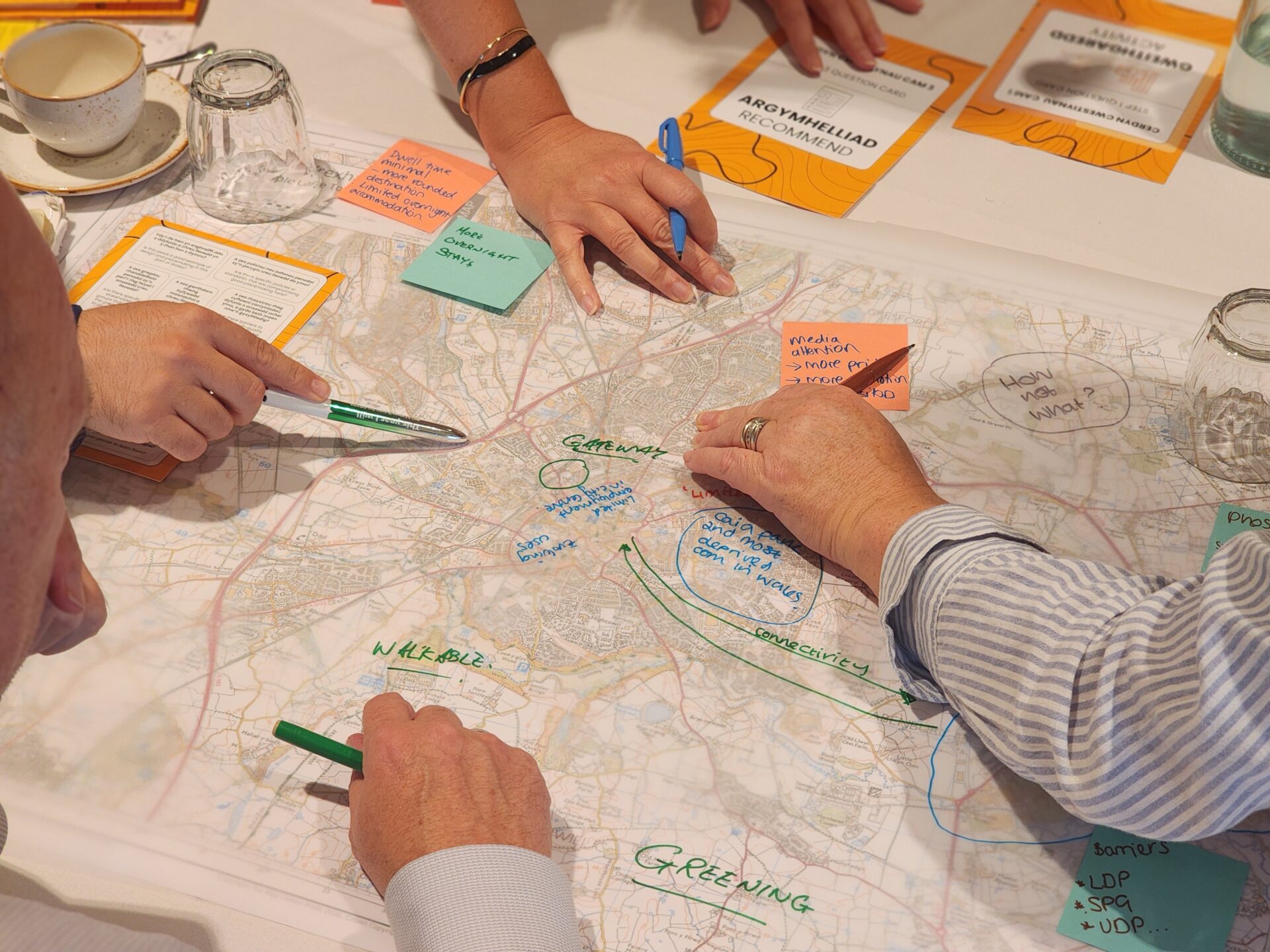
Urban Foundry used the six principles of the Placemaking Wales Charter to structure its understanding of each town and organise a programme of community and stakeholder engagement.
This included surveys, public consultation events organised around each principle, structured discussions with local stakeholders and town forums.
The process began by exploring the strengths and challenges of each town. Urban Foundry then developed potential actions, drawing on its urban design expertise and the Council’s knowledge of previous masterplanning work.
These emerging actions were taken back to communities and stakeholders for further discussion and prioritisation. They were grouped into easy wins, partnership actions and longer-term work.
The Charter helped bring different types of knowledge together. Community experience showed how people used and felt about each town. Urban design analysis explored what could change physically, while discussions with the Council grounded proposals in previous experience and the realities of delivery.
“Using the Placemaking Wales Charter as a structure allowed us to look at placemaking in the round and beyond just the buildings element of it.”
Urban Foundry
As Urban Foundry explained, the process brought together the human perspective of the community with an understanding of the physical opportunities and constraints.
“Effectively, what we were doing was bringing together the human voice from the community with the structural voice of understanding what could and couldn’t change.”
Urban Foundry
Importantly, the Charter did not prescribe the answers. It provided a shared structure that Urban Foundry could use independently, while responding to the distinct character and needs of three different towns.
This wider ownership is exactly what the Charter was intended to support.
“We’re here to provide support if and when people want to draw on it. But you know, there’s lots of very capable people out there who can just kind of pick it up and do it and run with it.”
Design Commission for Wales
Independent review strengthened the strategies
Once the draft strategies had been developed, they were submitted to us for a process similar to the Design Review used for major development proposals.
A panel considered their strategic direction, how effectively they worked as placemaking frameworks and whether they could support future decisions, investment and delivery.
This was our first formal involvement in the draft strategies. Although the review took place at an advanced stage, there was still time to refine the documents before publication.
The review recognised that all three strategies represented a significant body of work and provided a strong foundation for future placemaking. It welcomed their commitment to the Charter and the extensive engagement behind them.
It also identified opportunities to make the strategies more coherent, accessible and deliverable.
Key recommendations included:
-
Developing a concise and distinctive vision or set of ambitions for each town.
-
Creating an integrated spatial framework to show how movement, public realm, land use, green infrastructure, identity and development opportunities connect.
-
Clarifying priorities, early actions, sequencing, delivery partners and implementation.
-
Strengthening visual communication through diagrams, mapping, infographics and visual summaries.
-
Distinguishing more clearly between community perceptions and supporting factual evidence.
-
Continuing collaboration with communities, businesses and partners, including further engagement with younger people.
-
Considering an online dashboard to communicate priorities, responsibilities, funding and delivery progress.
The review went beyond affirming the work already completed. It recognised the depth of analysis and engagement while challenging the team to communicate the overall direction more clearly and show how individual actions could work together to create change.
Urban Foundry described this as finding the missing piece of the jigsaw: a clearer picture of what each town should look and feel like in the future.
“The design review process that we went through with those placemaking strategies, then allowed like the missing piece of the jigsaw in them to come to the fore, we recognised that overarching summary was missing.”
Urban Foundry
In response, a covering sheet was added to each strategy, summarising the current position and future direction. This provided a clearer overview that could be shared with others without losing the depth of work behind it.
Why involve DCFW?
This work demonstrates the value of staying involved beyond the development of a policy or framework.
Our role did not end when placemaking was introduced into Planning Policy Wales or when the Charter was launched. We helped establish a shared language, supported others to use it, kept the principles visible and provided independent challenge when they were applied in practice.
For Welsh Government policy teams, this approach can help bridge the gap between policy ambition and practical implementation. Bringing different professions together can expose tensions early and create a framework with wider ownership.
For local authorities and their partners, the principles offer a way to organise complex evidence and engagement without reducing placemaking to individual buildings or public realm projects. Independent review can then test whether a strategy has a clear vision, whether its themes connect and whether its priorities are understandable and deliverable.
Timing matters. The review added value at an advanced stage and informed the final refinement of the Carmarthenshire strategies. Earlier involvement would have created more opportunities for challenge to shape the strategies as they developed.
The same applies when strategies move into delivery. Early review gives us greater scope to influence proposals rather than comment on decisions that have already been made. However, it is never too late to involve us.
The wider strength of this approach lies in connecting national ambition with local experience. Policy provides direction. A shared framework makes it usable. Community and professional knowledge make it relevant to each place. Independent review then helps strengthen the route to delivery.
How DCFW can support your work
We support Welsh Government teams to develop and implement policy, bring cross-disciplinary partners together, and create practical frameworks and guidance.
We also work with local authorities and their partners as placemaking strategies are scoped, developed and translated into projects.
Our support is shaped around the policy area, organisation and place. The earlier we are involved, the more opportunity there is to add value.